-
Build Your Own Modular
Read More I have just released a new projects called BUILD YOUR OWN MODULAR, it is a ring binder book that contains all the PCBs and the documentation to build your own complete Eurorack modular. See the complete project page and where to buy here! BUILD YOUR OWN MODULAR - Project page
 -
New EuroClack Kits
Read More There are two new Eurorack kits, one is called ProtoPSU which is a breadboardable power supply to create +-12V and 5V from a 15V supply. The other is Analogue Meter which is a physical meter for Eurorack to observe DC and slow moving voltages.
 -
EuroClack - Mini Speaker
I am back to producing audio equipment! There is a new section under “Reasearch” called EuroClack, it is for synth DIY and I am producing and selling full kits / designing open source modules. The first full kit is a mini-speaker that fits into 6HP, see more inforation on the page.
Read More
-
Flip dots with Python
I have been working on a project for an artist that uses flip dot display panels. Flip dot/disc displays are a bygone technology that were typically used in places such as airports and stock exchanges, anywhere there was a need for dynamically displayed information. They were great for power efficiency as they retain their image with the power removed, therefore would have been much less power hungry than the light based displays of the time. Now superseded by LED displays that are just as efficient, but need less maintenance, they are still manufactured by Alfa-Zeta and used for more creative / nostalgic purposes. For this work I needed to create a program to show images on the panels, initially I was unsure of the source of the images, could it be a video? or programatically generated? So I decided to go as high level as possible and use Python on a Raspberry Pi. That way I would not have to re-write the program every time the ideas or the dimensions changed. I thought it would be great to be able to use Python Imaging Library pillow fork to manipulate the dots, that way I could draw shapes and text trivially, plus if any changes were needed I could write them quickly on the fly. I came up with FliPIL a sort of wrapper between PIL and the flip dot’s protocol.
Read More -
Boldport Club
Read More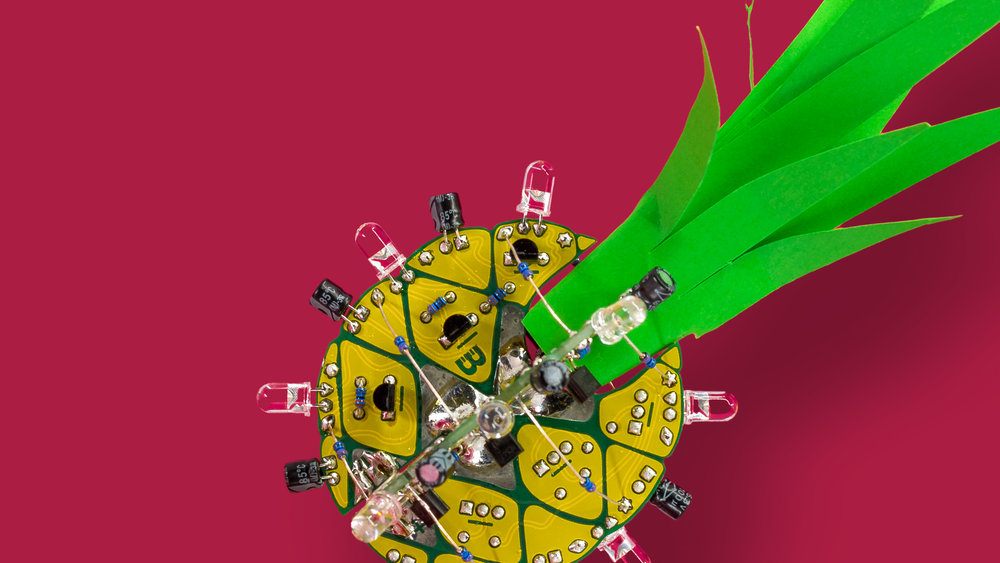 In 2017 I started working for Boldport a PCB design company that specialises in attractive circuit boards and runs boldport club a monthly subscription where you receive a highly designed electronic kit every month. Above is the very first kit I designed called Ananas it was a challenge to make my first design 3D but it turned out very well! Boldport decided to Change the way it works so I decided to write up how the design process works for a project kit. Please read this blog post to find out about how this unique design was made image courtesy Boldport ltd
 -
Paris Opera
Read More I had the rare opportunity to be a part of a project at the Palais Garnier, that is one of the main Opera house’s in Paris. I was working with Haroon Mirza to produce a live light and projection installation that interacted with a composition by Pierre Boulez called “Anthèmes II” and was a collaboration with the choreographer Wayne McGregor.